

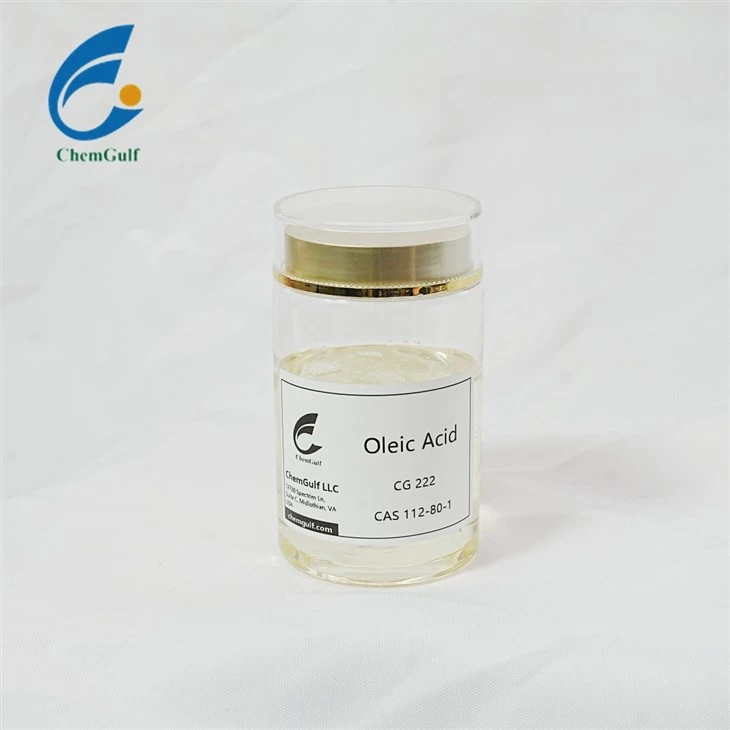

CG 222 Oleic Acid (CAS 112-80-1) is an unsaturated C18 fatty acid liquid used as a versatile raw material for surfactants, metal oleates, lubricant additives, and rust inhibitors.
Specifications
| Parameter | Details / Specification |
|---|---|
| Product Name | CG 222 Oleic Acid |
| CAS Number | 112-80-1 |
| IUPAC Name | (9Z)-Octadec-9-enoic Acid |
| Other Names | cis-9-Octadecenoic Acid; cis-Octadec-9-enoic Acid |
| Molecular Formula | C₁₈H₃₄O₂ |
| Molecular Weight | 282.47 g/mol |
| Functional Group & Chain | Carboxylic Acid / C18 (Monounsaturated, one cis double bond) |
| Appearance (25°C) | Light yellow liquid |
| Density (25°C) | Report |
| Acid Value (mg KOH/g) | 195–205 |
| Saponification Value (mg KOH/g) | 196–206 |
| Iodine Value (g I₂/100g) | 85–100 |
| Titer Temperature (°C) | 10 Max |
Typical Fatty Acid Distribution:
| Component | Chain Structure | Typical Content |
|---|---|---|
| Oleic Acid | C18:1 (cis-9) | ≥ 90.0% |
| Linoleic Acid | C18:2 (polyunsaturated) | ≤ 6.0% |
| Stearic Acid | C18:0 (saturated) | ≤ 2.0% |
| Palmitic Acid | C16:0 (saturated) | ≤ 2.0% |
Downstream Processing & Chemical Derivatives
CG 222 Oleic Acid is a highly versatile feedstock utilized in multiple industrial reactions due to its reactive carboxyl group and unsaturated chain.
Metal Oleates:
Reacts with inorganic bases to form metal salts (e.g., calcium, lithium, sodium oleates) used as lubricant additives, emulsifiers, and thickeners for greases.
Esterification:
Reacts with alcohols (e.g., glycerol) to produce esters like Glycerol Monooleate (GMO), used as emulsifiers, plasticizers, and synthetic lubricant base stocks.
Amidation & Amination:
Converted into amides and imidazolines for use as corrosion inhibitors, textile softeners, and emulsifiers.
Organic Ammonium Salts:
Reacts with organic amines to produce oleate salts for surfactant and specialty formulation systems.
Lubricant Additive Intermediates:
Acts as a starting material for friction modifiers and anti-rust additives. It can also undergo epoxidation for polymer stabilization applications.
Manufacturing Process
CG 222 Oleic Acid is produced through the controlled hydrolysis and refining of natural triglyceride oils and fats.
Hydrolysis & Separation:
Triglyceride oils are hydrolyzed to release crude fatty acids, which are then separated from the glycerol phase.
Refining & Purification:
The fatty acids undergo multi-stage fractional distillation and crystallization to remove color bodies, short-chain acids, and polyunsaturated impurities, isolating high-purity oleic fractions.
Packaging:
The finished material is evaluated and packaged for industrial supply.
Quality Control
Strict lot testing ensures consistency in physical properties and chemical composition before packaging.
Key Inspection Parameters:
Acid Value (free fatty acid content), Saponification Value, Iodine Value (degree of unsaturation), Density, Appearance, and Titer Temperature (solidification behavior).
Testing Methods:
Every production batch undergoes Gas Chromatography (GC) to verify the fatty acid profile and titration to confirm acid and iodine values, ensuring strict compliance with specifications.
Technical Documentation
We provide comprehensive documentation to support product evaluation, compliance, and safe handling.
COA (Certificate of Analysis):
Provided with every shipment, detailing actual measured values for Acid Value, Iodine Value, and other specifications.
TDS (Technical Data Sheet):
Product specifications, physical properties, and application information.
SDS (Safety Data Sheet):
Compliant with GHS standards, covering safe handling, transportation, and storage.
Reference Spectra:
NMR and IR spectra available for structural identification.

NMR Reference Spectrum

IR Reference Spectrum
FAQ
Q: What are the main industrial applications of oleic acid?
A: It is widely used as a chemical intermediate for surfactants, detergents, emulsifiers, metal oleates, lubricant additives, rust inhibitors, and personal care formulations.
Q: Can CG 222 be used to manufacture metal oleates?
A: Yes. It readily reacts with inorganic bases to form metal oleates (e.g., calcium oleate), which are used in lubricant, emulsifier, and specialty chemical formulations.
Q: What do the acid value and iodine value indicate?
A: The Acid Value measures the free acid functionality, while the Iodine Value indicates the degree of unsaturation. Both are critical parameters for evaluating quality.
Q: What packaging options are available?
A: Standard packaging is 180 kg drums. Bulk quantities and other custom packaging arrangements are available based on your order requirements.
Q: Can I request a TDS or SDS before placing an order?
A:Yes. The TDS is available for download, and the SDS can be provided upon request. Contact our sales team for product documentation and quotation details.
Contact our sales team for product documentation and quotation details.
Send InquirySpecification
|
Property |
Specification |
Typical Value |
|
Appearance, 25 °C |
Light yellow liquid |
Light yellow liquid |
|
Density, g / mL, 25 °C |
Report |
0.895 |
|
Acid Value, mg KOH/g |
195 - 205 |
200 |
|
Saponification Value, mg KOH/g |
196 - 206 |
200 |
|
Iodine Value, g I2/100g |
85 - 100 |
93 |
|
Titer temperature, °C |
10 Max |
8.8 |
Custom specification is available upon request.
Packaging
180 kg / drum, 396 lbs / drum
Bulk
Other packaging sizes available upon request
Pricing information / quote
Please contact us for more information.
Availability and Lead Time
Availability and lead time are dependent on the quantity of orders. Please contact us for more information.
Applications
CG 222, Oleic acid, is useful for a variety of applications, which include, but are not limited to,
● Chemical intermediate
● Emollient agent
● Emulsifying agent
● Softener
● Anti-rust agent
● Raw material to make lubricant additives, such as friction modifiers and anti-rust agents, and base oils.
CG 222, Oleic acid, is widely used in many industries, which include, but are not limited to, Food, cosmetics, lubricants, personal care and pharmaceuticals, etc.
TDS / SDS
(A PDF available to download)
SDS, available upon request
Manufacturing Process
Oleic acid is typically manufactured by hydrolyzing triglycerides. The crude product is a mixture of many fatty acids. The refinement usually is achieved by distillation to isolate Oleic acid from other fatty acids in the mixture. Other refinements include washing with water and crystallization of unwanted fatty acids.
Chemical Reactions
Oleic acid can react with inorganic bases to form Oleate salts, such as Calcium Oleate, which can be used as a thickener and emulsifier.
Oleic acid can react with organic amines, such as Oleylamine, to form organic ammonium salts.
Like other carboxylic acids, Oleic acid reacts with alcohols to form esters via an esterification reaction. For example, glycerol mono- oleate, also know as GMO, is prepared by reacting oleic acid with glycerol.
Properties
|
Chemical Formula |
C18H34O2 |
|
Molecular Weight |
282.47 |
|
Appearance, 25 °C |
Colorless to light yellow liquid |
|
Melting Point |
13 °C (55 °F) |
|
Initial boiling point |
360 °C (680 °F) |
|
Density, 25 °C, g/cm3 |
0.895 |
Spectra
NMR

SDBS : https://sdbs.db.aist.go.jp/ , National Institute of Advanced Industrial Science and Technology, January, 26th, 2025
IR

SDBS : https://sdbs.db.aist.go.jp/ , National Institute of Advanced Industrial Science and Technology, January, 26th, 2025
Links
See more products at www.chemgulfllc.com
Hot Tags: cg 222 oleic acid, cas 112-80-1, (9z)-octadecenoic acid, cis-octadec-9-enoic acid, China cg 222 oleic acid, cas 112-80-1, (9z)-octadecenoic acid, cis-octadec-9-enoic acid manufacturers


