

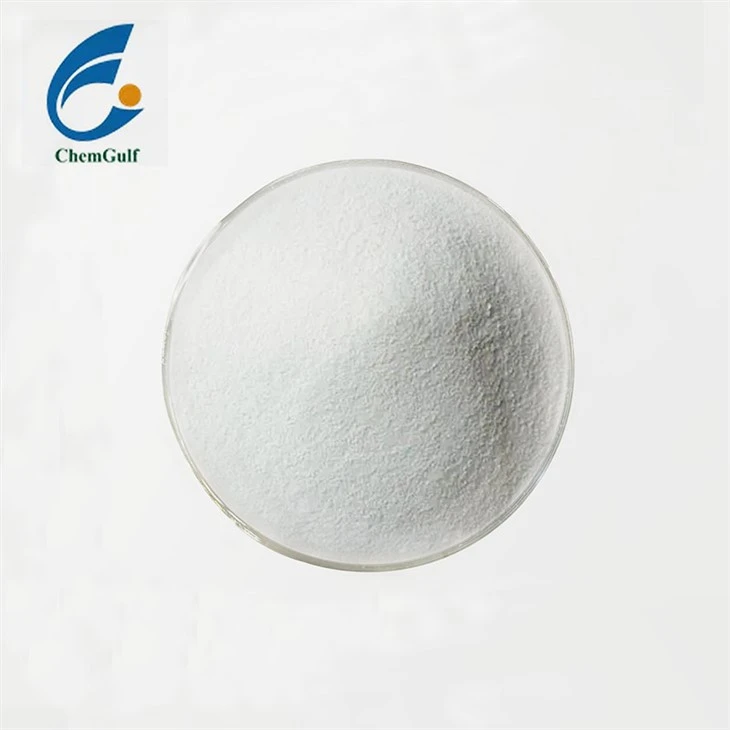

CG 212 Adipic Acid (CAS 124-04-9) is a C6 dicarboxylic acid (C₆H₁₀O₄) serving as a key raw material for Nylon 6,6, polyurethanes, plasticizers, and synthetic lubricant esters.
Contact ChemGulf for product inquiries, pricing, and purchasing requirements.
Send InquiryProduct Specifications & Technical Data
| Parameter | Details / Specification |
|---|---|
| Product Name | Adipic Acid |
| Product Code | CG 212 |
| CAS Number | 124-04-9 |
| Chemical Name | Hexanedioic Acid |
| Molecular Formula | C₆H₁₀O₄ |
| Molecular Weight | 146.14 g/mol |
| Grade | Industrial Grade |
| Appearance (25°C) | White Powder |
| Purity (%) | 99.0 Min |
| Moisture (wt%) | 0.20 Max |
| Melting Point | 152°C |
| Initial Boiling Point | 338°C (Decomposes) |
| Density (20°C) | 1.36 g/cm³ |
| Water Solubility (10°C) | 14 g/L |
Solubility & Chemical Reactivity
Adipic Acid has defined solubility and reaction characteristics relevant to industrial processing and formulation.
- Water Solubility: Limited solubility in cold water, increasing with temperature.
- Esterification: Reacts with alcohols to form adipate esters used in plasticizers and synthetic lubricants.
- Polycondensation: Reacts with diamines to form polyamide polymers, including Nylon 6,6.
- Thermal Behavior: Melting point of approximately 152°C; decomposes at elevated temperatures rather than undergoing normal boiling.
Industrial Applications & End-Use Industries
Nylon 6,6
Reacts with hexamethylenediamine (HMD) to produce engineering plastics, fibers, and automotive parts.
Polyurethanes (PU)
Key raw material for polyester polyols used in elastomers, adhesives, and foams.
Plasticizers (e.g., DOA)
Provides low-temperature flexibility and durability to PVC and polymers.
Coatings & Resins
Used in alkyd and unsaturated polyester resins for protective industrial coatings.
Synthetic Lubricants
Base material for high-performance synthetic ester fluids.
Quality Assurance
CG 212 Adipic Acid is manufactured in ISO-certified facilities with strict process controls to ensure consistent, high-purity output.
Batch Testing & Traceability
Every production batch undergoes comprehensive laboratory testing for purity (≥ 99.0%), moisture (≤ 0.20 wt%), and appearance (white powder). Each shipment includes a certified COA for traceability.
Process Control
Continuous crystallization and multi-stage purification are used to strictly control iron, water, and volatile acid impurities.
Pre-Shipment Verification
Pre-shipment samples (PSS) and analytical test reports are available for buyer qualification before bulk dispatch. TDS and SDS are provided for technical and safety evaluation.
Packaging & Logistics
Packaging Options
Standard 25 kg polypropylene (PP) woven bags with inner PE liners (approx. 55 lbs), and 500 kg / 1,000 kg FIBC jumbo bags (approx. 2,204 lbs) with pallet options. Custom packaging sizes are available upon request.
Storage Conditions
Store in a cool, dry, well-ventilated warehouse away from direct sunlight, moisture, strong oxidizers, and alkaline substances.
Shipping & Ports
Shipped globally from major international ports with FOB, CFR, or CIF terms supported. Complete transit documentation is provided per international chemical standards.
Frequently Asked Questions (FAQ)
Q: Can you provide samples, TDS, SDS, and COA?
A: Yes. We offer free 500g–1kg lab samples (buyer pays courier or it's deducted from the first order). TDS, SDS, and batch-specific COA are provided for quality verification.
Q: What documentation is provided with each shipment?
A: Every shipment includes a Commercial Invoice, Packing List, Bill of Lading, Certificate of Origin (CO/Form A/E), and a batch-specific COA.
Q: What are the accepted payment terms for bulk orders?
A: We accept T/T and Irrevocable L/C at sight. Specific credit terms can be evaluated for long-term partners.
Q: What is the shelf life and storage requirement?
A: The shelf life is 24 months from the date of manufacture when stored unopened in cool, dry, and moisture-free conditions.
Q: Do you accept bulk orders and how can I get a quotation?
A: Yes. Please provide your required quantity, destination port, and packaging preference. We will provide a tailored quotation based on your purchasing requirements.
Send your purchasing requirements to ChemGulf for a quotation.
Request a QuoteSpecification
|
Property |
Specification |
Typical Value |
|
Appearance, 25 °C |
White powder |
White powder |
|
Purity, % |
99 min |
99.5 |
|
Moisture, wt% |
0.2 max |
0.1 |
Custom specification is available upon request.
Packaging
25 kg / bag, 55 lbs / bag
1,000 kg / supersack, 2,204 lbs / supersack
Other packaging sizes available upon request
Pricing information / quote
Click here for prices of oleamide.
Availability and Lead Time
Availability and lead time are dependent on the quantity of orders. Please contact us for more information.
Applications
CG 212, Adipic acid, is useful for a variety of applications, which include, but are not limited to,
● Chemical intermediate
● Precursor for food ingredients
● Raw material for lubricant synthetic ester base fluids, e.g., Dioctyl Adipate (DOA) CAS 103-23-1
● Monomer for production of nylon
● Monomer for production of polyurethane
● Raw material for production of plasticizers
CG 212, Adipic acid, is widely used in many industries, which include, but are not limited to, Food, plastics, lubricants, rubber. and pharmaceuticals, etc.
TDS / SDS
(A PDF available to download)
SDS, available upon request
Manufacturing Process
Adipic acid is manufactured by oxidizing cyclohexanol, using nitric acid as the oxidant, via a multiple step process. Cyclohexanone is an intermediate in the production. Glutaric acid and succinic acid are two common by-products.
Adipic acid is also produced by oxidation of cyclohexene with hydrogen peroxide.
An alternative process to make adipic acid is carbonylation of butadiene with carbon oxide.
Chemical Reactions
Adipic acid can react with inorganic bases to form adipate salts.
Adipic acid can react with organic amines to form ammonium adipates.
Adipic acid reacts with alcohols to form esters via an esterification reaction. By adjusting the molar ratio of the adipic acid to the alcohol, the end product can be mono- or di- esters.
Adipic acid reacts with diamines, such as hexamethylene diamine, to undergo a polymerization reaction.
Properties
|
Chemical Formula |
C6H10O4 |
|
Molecular Weight |
146.14 |
|
Appearance, 25 °C |
White powder |
|
Melting Point |
152 °C (306 °F) |
|
Initial boiling point |
338 °C (640 °F), decomposes |
|
Density, 20 °C, g/cm3 |
1.36 |
|
Solubility in water, 10 °C, g/L |
14 |
Spectra
NMR

SDBS : https://sdbs.db.aist.go.jp/ , National Institute of Advanced Industrial Science and Technology, January, 23rd, 2025
IR
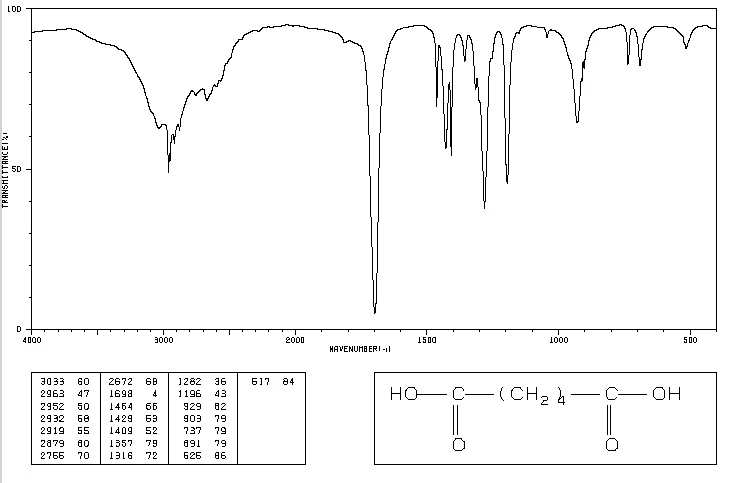
SDBS : https://sdbs.db.aist.go.jp/ , National Institute of Advanced Industrial Science and Technology, January, 23rd, 2025
Links
See more products at www.chemgulfllc.com
Hot Tags: cg 212 adipic acid, cas 124-04-9, hexanedioic acid, China cg 212 adipic acid, cas 124-04-9, hexanedioic acid manufacturers


