

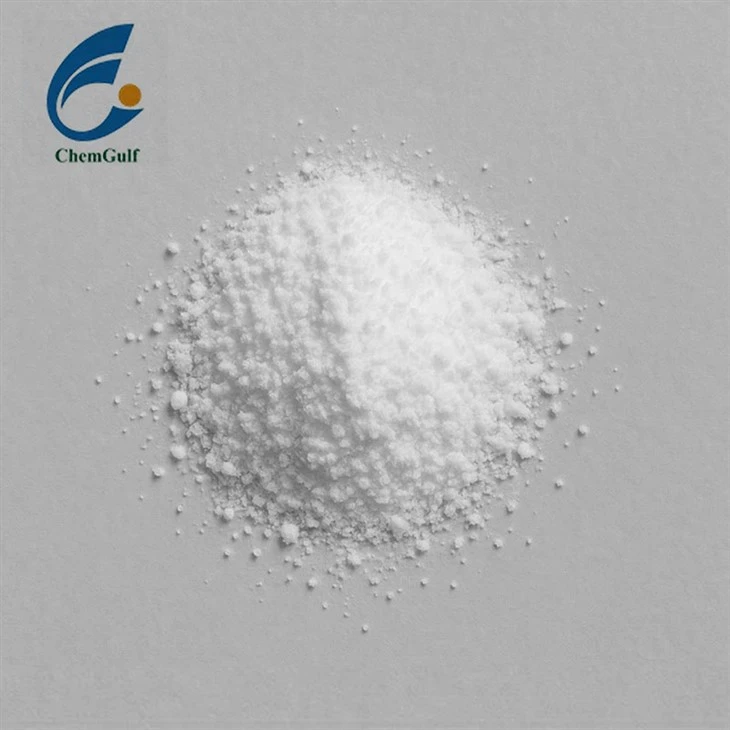
CG 201 Stearic Acid (CAS 57-11-4) is a saturated C18 fatty acid (white waxy solid, typically blended with palmitic acid) used as a lubricant, release agent, emulsifier, and chemical intermediate in plastics, rubber, and personal care.

Stearic Acid Structure

Stearic Acid 3D Molecular Structure
Contact ChemGulf for CG 201 Stearic Acid purchasing inquiries.
Send InquiryProduct Specifications
| Parameter | Specification |
|---|---|
| Chemical Name | N-Octadecanoic Acid (Stearic Acid) |
| CAS Number | 57-11-4 |
| Chemical Formula | C₁₈H₃₆O₂ |
| Molecular Weight | 284.48 g/mol |
| Appearance (25°C) | White Waxy Solid |
| Acid Value (mg KOH/g) | 200–210 |
| Saponification Value (mg KOH/g) | 200–210 |
| Iodine Value (g I₂/100g) | 1.0 Max |
| Titer Temperature (°C) | Report |
| Moisture (wt%) | 0.3 Max |
| Melting Point | 69°C |
| Initial Boiling Point | 361°C (Decomposes) |
| Density (20°C) | 0.94 g/cm³ |
| Water Solubility (20°C) | 0.00029 g/100g |
Fatty Acid Composition
Industrial CG 201 Stearic Acid is a mixture of long-chain fatty acids, predominantly saturated, whose specific ratio determines the product's physical properties.
- Stearic Acid (C18:0): The principal saturated component, typically comprising ≥ 40–50% of the blend. It provides the solid structure and high melting point.
- Palmitic Acid (C16:0): A major accompanying saturated fatty acid, usually present at 40–50%.
- Oleic Acid (C18:1): An unsaturated minor component, typically ≤ 5–10%, which directly influences the Iodine Value (≤ 1.0 g I₂/100g) and Titer Temperature (Typical 60°C).
Functional Properties & Processing Characteristics
Lubrication & Dispersion
Acts as an internal/external lubricant to reduce melt viscosity and friction during extrusion, calendering, and molding. It also promotes uniform dispersion of fillers and pigments in polymers.
Mold Release & Surface Modification
Its waxy structure (Melting Point ~69°C) reduces adhesion to processing equipment, improving surface finish and release properties in molded goods.
Emulsification & Saponification
Reacts readily with alkalis (e.g., NaOH, KOH) to form metal soaps, serving as a key raw material for stable oil-in-water emulsions and stearate derivatives.
Thermal Characteristics
Remains a stable waxy solid at ambient temperatures and melts smoothly during heated processing.
Industrial Applications
CG 201 Stearic Acid is a versatile processing aid and intermediate used across major industries:
Plastics & PVC
Acts as a lubricant and thermal stabilizer co-additive in extrusion and calendering.
Rubber
Serves as an activator for vulcanization and an internal mold release agent.
Metal Soaps & Surfactants
A key raw material for zinc, calcium, and magnesium stearates, as well as soaps.
Personal Care
Functions as an emulsifier, thickener, and pearlizing agent in creams and soaps.
Candles & Wax
Controls hardness, opacity, and burn rate.
Quality Control
CG 201 Stearic Acid is evaluated using key fatty acid quality parameters to support industrial formulation and processing requirements.
- Acid Value Testing: Measures the free fatty acid content and supports product specification control.
- Saponification Value Testing: Determines the alkali requirement for saponification and helps characterize the fatty acid material.
- Iodine Value Testing: Measures the degree of unsaturation in the fatty acid mixture.
- Titer Temperature Testing: Determines the solidification characteristics of the fatty acid product.
- Moisture & Appearance Inspection: Controls moisture content and verifies the white waxy solid appearance.
Technical Documents
ChemGulf provides technical documentation to support product evaluation, purchasing, and industrial application.
- Technical Data Sheet (TDS): Product specifications, physical properties, and technical information.
- Safety Data Sheet (SDS): Handling, storage, transportation, and safety information.
- Certificate of Analysis (COA): Batch-specific analytical results for quality verification.
FAQ
Q: What are the main components of industrial Stearic Acid?
A: It primarily contains Stearic Acid (C18:0) and Palmitic Acid (C16:0), with minor amounts of other fatty acids depending on the grade.
Q: What industries and physical forms are available?
A: Used in PVC, rubber, metal soaps, personal care, and candles. Available in flake (faster dry-blending) or bead (better flow, less dust) forms with identical chemical specs.
Q: What are the storage requirements?
A: Store in a cool, dry, well-ventilated area away from heat and oxidizers. Keep below 35°C to prevent caking.
Q: Can you provide TDS, SDS, and COA?
A: Yes. TDS and SDS are available upon request, and batch-specific COA documentation is provided for quality verification.
Q: What is the delivery lead time?
A: Lead time depends on your required quantity and destination. Standard production and logistics schedules are confirmed during the quotation process.
Q: How can I request a quotation?
A: Please provide your required quantity, preferred packaging/form (flake or bead), and destination port. We will provide tailored pricing and supply information.
Contact ChemGulf for pricing and supply information.
Request a QuoteSpecification
|
Property |
Specification |
Typical Value |
|
Appearance, 25 °C |
White waxy solid |
White waxy solid |
|
Acid Value, mg KOH/g |
200 - 210 |
205 |
|
Saponification Value, mg KOH/g |
200 - 210 |
205 |
|
Iodine Value, g I2/100g |
1.0 max |
0.5 |
|
Titer temperature, °C |
Report |
60 |
|
Moisture, wt% |
0.3 max |
0.1 |
Custom specification is available upon request.
Packaging
25 kg/bag, 55 lbs/bag
Other packaging sizes available upon request
Pricing information/quote
Click here for prices of CG 201, Stearic acid.
Availability and Lead Time
Availability and lead time are dependent on the quantity of orders. Please contact us for more information.
Applications
CG 201, Stearic acid, is useful for a variety of applications, which include, but are not limited to,
● Chemical intermediate
● Emulsifier
● Detergent
● Rust inhibitor
● Softening and release agent
CG 201, Stearic acid, is widely used in many industries, which include, but are not limited to, Food, plastics, lubricants, personal care, cosmetics, and pharmaceuticals, etc.
TDS / SDS
(A PDF available to download)
SDS, available upon request
Manufacturing Process
Stearic acid is typically manufactured by hydrolyzing triglycerides. The crude product is a mixture of many fatty acids. The refinement usually is achieved by distillation.
Stearic acid may also be manufactured by hydrogenation of oleic acid.
Chemical Reactions
Stearic acid can react with inorganic bases to form stearate salts, such as Zinc Stearate, which has an application in plastics.
Stearic acid can react with organic bases, such as oleylamine, to form organic salts.
Like other carboxylic acids, Stearic acid reacts with alcohols to form esters via an esterification reaction.
Properties
|
Chemical Formula |
C18H36O2 |
|
Molecular Weight |
284.48 |
|
Appearance, 25 °C |
White solid |
|
Melting Point |
69 °C (156 °F) |
|
Initial boiling point |
361 °C (682 °F), decomposes |
|
Density, 20 °C, g/cm3 |
0.94 |
|
Solubility in water, 20 °C, g/100g |
0.00029 |
Spectra
NMR
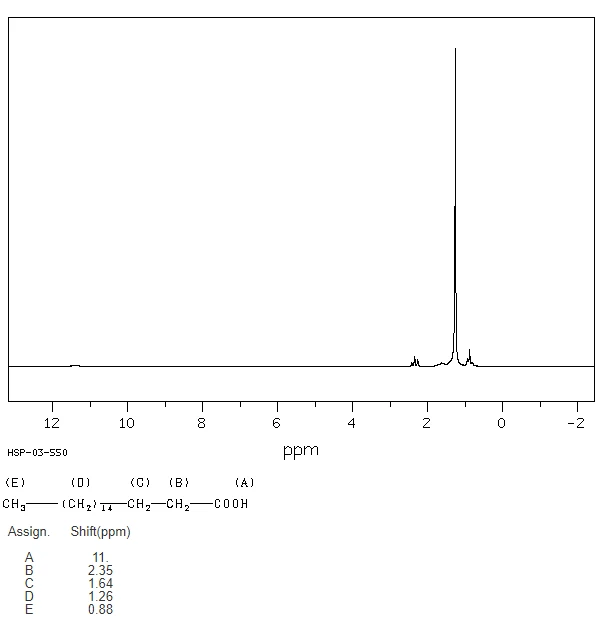
SDBS : https://sdbs.db.aist.go.jp/ , National Institute of Advanced Industrial Science and Technology, January, 23rd, 2025
IR
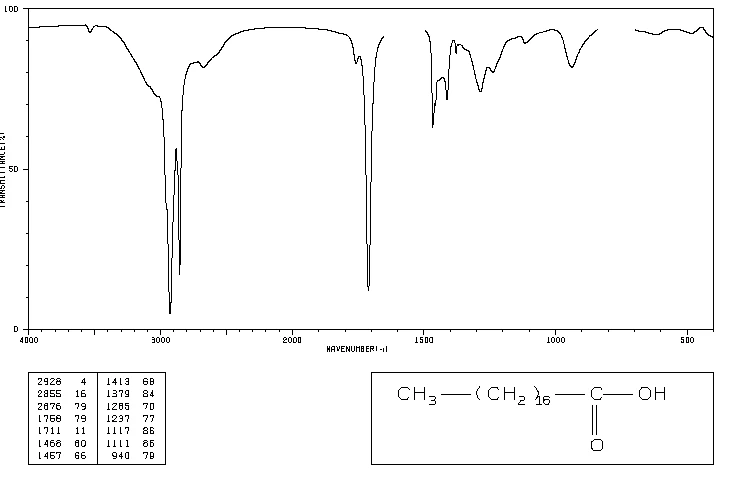
SDBS : https://sdbs.db.aist.go.jp/ , National Institute of Advanced Industrial Science and Technology, January, 23rd, 2025
Links
See more products at www.chemgulfllc.com
Hot Tags: cg 201 stearic acid, cas 57-11-4, n-octadecanoic acid, China cg 201 stearic acid, cas 57-11-4, n-octadecanoic acid manufacturers


