

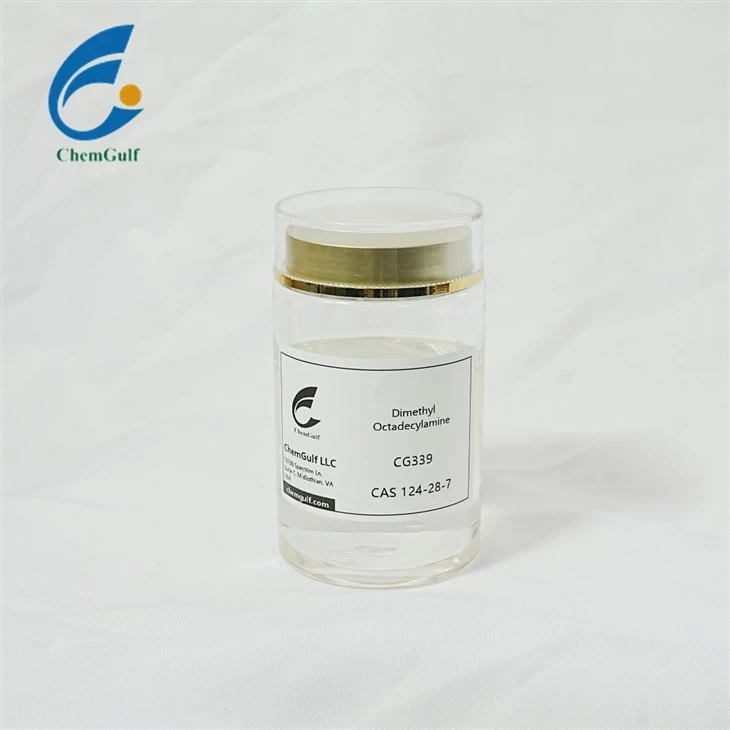
CG 339 Dimethyl Octadecylamine (CAS 124-28-7; C20H43N, MW 297.56), a C18 linear-chain tertiary amine with a melting point of ~22–23°C, is a chemical intermediate used in quaternary ammonium compounds, amine oxides, specialty surfactants, lubricant additives, antistatic agents, corrosion inhibitors, and dispersants.

Technical Specifications
| Product Code | CG 339 |
|---|---|
| Chemical Name | N,N-Dimethyloctadecylamine |
| CAS Number | 124-28-7 |
| Synonyms | Dimethyl Stearylamine, Stearyldimethylamine, DMA18 |
| Chemical Family | Aliphatic Tertiary Amine |
| Molecular Formula | C20H43N |
| Molecular Weight | 297.56 g/mol |
| Alkyl Chain Length | C18 |
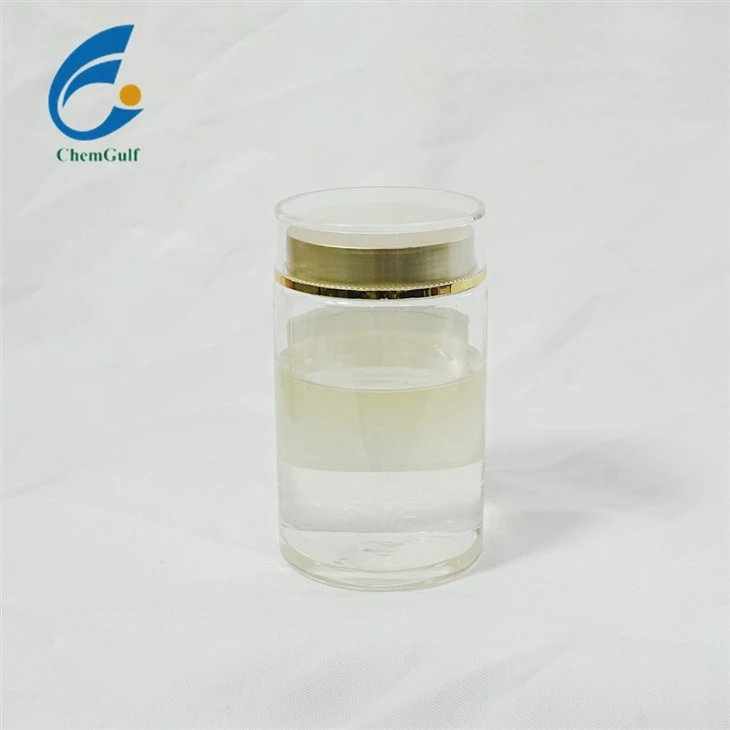
| Appearance (25°C) | Colorless to Light Yellow Clear Liquid (Typical: Light Yellow Liquid) |
| Total Amine Value (mg KOH/g) | 183–190 |
| Tertiary Amine Content (%) | 97 Min. |
| Color (APHA) | 30 Max. |
| Water Content (wt.%) | 0.20 Max. |
| Melting Point | Approx. 22–23°C |
| Boiling Point | Approx. 160°C at 0.5 mmHg |
| Density | Approx. 0.80 g/cm³ |
| Flash Point | Above 150°C |
| Water Solubility | Practically Insoluble / Very Slightly Soluble |
C18 Molecular Structure & Thermal Characteristics
- Structure: Saturated C18 (stearyl) linear chain bonded to a tertiary amine nitrogen bearing two methyl groups - CH3(CH2)17N(CH3)2
- Solubility: Insoluble in water; soluble in alcohols, ethers, and most non-polar organic solvents
Key Features
- Long C18 Hydrophobic Chain: Extended hydrophobic segment suited to long-chain cationic surfactants, antistatic agents, and lubricant additives.
- Reactive Tertiary Amine: Electron pair reacts with acids, alkylating agents, and oxidizers to form functional derivatives.
- Temperature-Dependent State: Melting point ~22–23°C (boiling point 347°C at atmospheric pressure); liquid above melting range, may solidify at lower temperatures - temperature control needed for storage, pumping, and transfer.
- C18 Retention in Derivatives: The C18 segment is retained after conversion, providing a long hydrophobic block in quaternary ammonium and amine oxide products.
Industrial Applications Downstream Uses
- Surfactants & Conditioning: Base for long-chain quaternary ammonium compounds, amine oxides, and betaines - used in textile softeners, antistatic agents, hair conditioners, and personal care formulations.
- Industrial Additives: Intermediate for lubricant additives/friction modifiers, corrosion inhibitors (including oilfield pipeline protection), dispersants, pigment-processing agents, and specialty resin additives.
- Oilfield & Processing Chemicals: Used in petroleum extraction as anti-adhesive, scale preventative, and corrosion inhibitor; also in surface treatment and textile auxiliaries.
Chemical Reactivity & C18 Derivative Production
- Quaternization: Reacts with alkylating agents (methyl chloride, benzyl chloride, dimethyl/diethyl sulfate) to yield C18 Quaternary Ammonium Compounds (e.g., octadecyltrimethyl- and benzyldimethyloctadecyl-ammonium salts).
- Oxidation: Controlled reaction with hydrogen peroxide (H2O2) to produce Octadecyldimethylamine Oxide.
- Betaine Formation: Reacts with sodium chloroacetate to synthesize C18 Alkyl Betaine.
- Neutralization: Combines with organic/inorganic acids to form C18 Amine Salts (e.g., antistatic agent SN via nitric acid/ethylene oxide).
Storage & Handling Conditions
- Storage Environment: Store in tightly closed containers in a cool, dry, and well-ventilated area away from direct sunlight, moisture, and incompatible reactive chemicals. Keep away from ignition sources.
- Handling Precautions: Classified as a corrosive material (Hazard Class 8). Operators must utilize proper personal protective equipment (PPE) including chemical-resistant gloves, protective clothing, and eye/face protection to avoid direct contact.
FAQ
Q1: What is its physical state at room temperature?
It is a clear liquid or soft, low-melting waxy solid near 23°C (melting point ~22–23°C). Mild heating may be required to fully liquefy drum contents before unloading or processing.
Q2: Is it soluble in water?
Practically insoluble or very slightly soluble due to the long C18 hydrocarbon chain; compatible with selected organic solvents.
Q3: How does it differ functionally from CG 329 (C12)?
The longer C18 chain (vs. C12) gives higher molecular weight, a higher melting point, and enhanced surface lubricity, hydrophobic conditioning, and structural persistence-ideal for heavy-duty textile softeners and hair care.
Q4: What are the standard reaction paths for end-use surfactants?
Primarily quaternization (alkylation with methyl chloride or dimethyl sulfate) to form long-chain cationic surfactants, or acid neutralization for specialized industrial uses.
Q5: What packaging is available?
Standard: 160 kg/drum. Alternative and bulk arrangements are negotiable based on order quantity and delivery requirements.
For product details, specifications, or a quotation, please contact our sales team.
Send InquirySpecification
|
Property |
Specification |
Typical Value |
|
Appearance, 25 °C |
Colorless to light yellow clear liquid |
Light yellow liquid |
|
Total Amine Value, mg KOH / g |
183 - 190 |
186 |
|
Color, APHA |
30 Max |
10 |
|
Water content, % wt |
0.2 Max |
0.1 |
|
Tertiary amine content, % |
97 Min |
99.0 |
Packaging
160 kg / drum, 352 lbs / drum
Other packaging sizes available upon request
Pricing information / quote
We guarantee our prices are the most competitive.
All prices below are delivered within the US, excluding Alaska and Hawaii.
1-8 drums: $3.95/lb
9-20 drums: $3.75/lb
21-40 drums: $3.50/lb
Over 40 drums: $3.40/lb
Prices for other packaging, click here.
Availability and Lead Time
Availability and lead time are dependent on the quantity of orders. Please contact us for more information.
Applications
Dimethyl octadecylamine is widely used in many industries. The applications of dimethyl octadecyl amine include, but are not limited to,
Surfactants and intermediate of surfactants.
● Lubricant additives.
● Dispersing agent.
● Corrosion inhibitor.
● Friction modifier.
● Intermediate for cosmetic applications.
● Catalyst for Urethanes and Epoxies.
● Antistatic agents.
● Chemical intermediates.
TDS / SDS
(A PDF available to download)
SDS, available upon request
Manufacturing Process
Not available for now.
Chemical Reactions
Dimethyl octadecylamine reacts with acids, including both organic and inorganic acids, to form ammonium salt.
Properties
|
Chemical Formula |
C20H43N |
|
Molecular Weight |
297.6 |
|
Appearance, 25 °C |
Colorless to light yellow liquid |
|
Melting Point |
22°C (72°F) |
|
Initial boiling point |
160 °C (320 °F) at 0.5 mm Hg |
|
Flash point, closed cup |
> 150 °C (302 °F) |
|
Density |
0.80 g/cm3 |
Spectra
NMR: Not Available
IR: Not Available
Links
See more products at www.chemgulfllc.com
Hot Tags: cg339 dimethyl octadecylamine, cas 124-28-7, dimethyl stearylamine, China cg339 dimethyl octadecylamine, cas 124-28-7, dimethyl stearylamine manufacturers


