

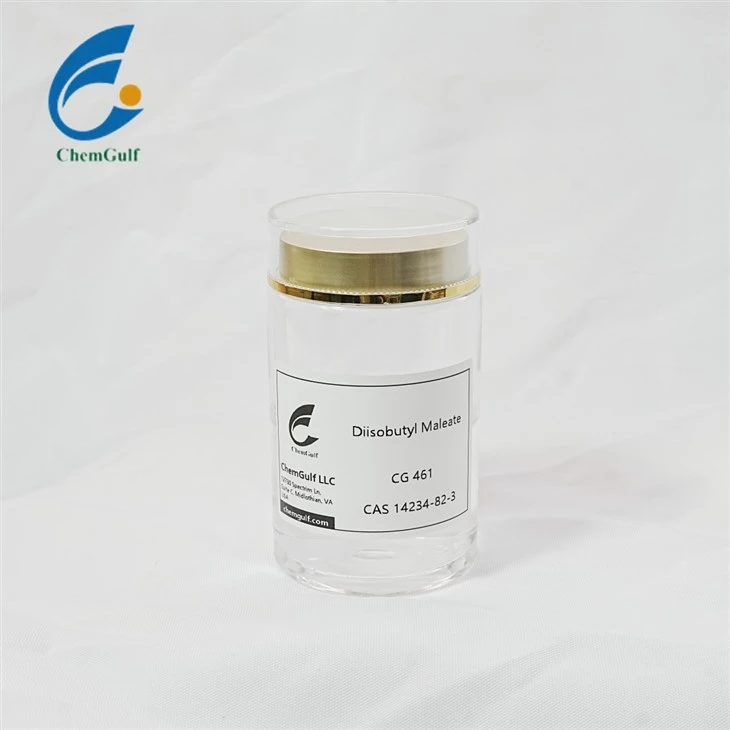

CG 461 Diisobutyl Maleate (DIBM, CAS 14234-82-3; purity ≥98.5%), an unsaturated maleic diester featuring a reactive C=C double bond and two isobutyl ester groups, serves as a functional monomer, resin intermediate, and specialty plasticizer for emulsion polymerization, resin modification, coatings, adhesives, and polymer formulations.
Technical Specifications & Physical Properties
| Property | Specification |
|---|---|
| Product Code | CG 461 |
| Chemical Name | Diisobutyl Maleate |
| Abbreviation | DIBM |
| CAS Number | 14234-82-3 |
| EC Number | 238-102-4 |
| IUPAC Name | bis(2-methylpropyl) (Z)-but-2-enedioate |
| Molecular Formula | C12H20O4 |
| Molecular Weight | 228.28 g/mol |
| Functional Group | Unsaturated Diester |
| Appearance (25°C) | Transparent Liquid |
| Color (Hazen) | 20 Max. |
| Purity (%) | 98.5 Min. |
| Density (g/mL, 20°C) | 0.988 Typical |
| Total Acid Number (mg KOH/g) | 0.1 Max. |
| Flash Point (Open Cup, °C) | 120 Min. |
| Isobutanol Residue (%) | 0.1 Max. |
| Water Content (%) | 0.1 Max. |
Chemical Structure & Functional Characteristics
Structure: Central cis-butenedioate (maleate) core esterified with two branched isobutyl groups - [(CH3)2CHCH2OOCCH=CHCOOCH2CH(CH3)2] | Formula: C12H20O4 | MW: 228.28 g/mol
Reactivity (Electron-Deficient C=C): Conjugated carbonyls draw electron density from the double bond, enabling free-radical alternating copolymerization with electron-rich monomers (e.g., vinyl acetate, vinyl chloride).
Steric Shielding: Branched isobutyl chains protect the ester linkages, providing higher alkaline hydrolysis resistance than short-chain maleates (DMM/DEM) and lower viscosity/faster kinetics than long-chain maleates (DOM).
Solubility: Insoluble in water (<0.05 g/100 mL at 20°C); completely miscible with alcohols, ketones, esters, aromatics, and common organic monomers.
Industrial Applications & Formulation Benefits
Emulsion Polymerization
Copolymerizes with vinyl acetate (internal plasticization for VAE paints/adhesives) and vinyl chloride (lowers Tg for PVC processing).
Resin & Coating Modification
Adjusts MFFT, scrub resistance, and adhesion in acrylic latexes; reactive intermediate for polyester/maleate resins.
Surfactant Synthesis
Reacts with sodium bisulfite to form diisobutyl sodium sulfosuccinate (industrial wetting agent).
Plasticizer
Acts as an internal plasticizer to modify flexibility and processing (performance depends on compatibility and loading).
Formulation Compatibility
Monomer Systems: Miscible with VAM, butyl acrylate, 2-EHA, MMA, styrene, and vinyl chloride; incorporation depends on reactivity, feed, initiator, and conditions.
Initiators & Surfactants: Compatible with standard free-radical initiators (persulfates, redox systems) and anionic/non-ionic surfactant packages.
Processing Control: Due to low homopolymerization rates, DIBM is typically fed continuously with the primary monomer (e.g., VAM) to ensure uniform composition and minimize residual monomer.
Resin & Organic Systems: Suitable for maleate-based resins and organic formulations; compatibility with solvents/plasticizers should be assessed per formulation.
USA Stock, Packaging & Supply Information
Inventory & Logistics: Stocked in U.S. warehouses (Houston, TX and East Coast hubs) for fast FTL/LTL domestic delivery and export; shipment scheduling depends on order quantity.
Packaging Options
- Drums: 200 kg tight-head steel drums (80 drums / 16,000 kg per 20' FCL)
- IBC Totes: 1,000 kg composite IBCs (20 totes / 20,000 kg per 20' FCL)
- Bulk: ISO tank containers available
Documentation: Batch-specific COA, OSHA-compliant SDS, TDS, and TSCA compliance confirmation accompany each shipment.
FAQ
Q: Can it be used in emulsion polymerization?
A: Yes, as a comonomer with vinyl acetate, styrene, and acrylics.
Q: How does it compare to DBM and DOM?
A: Offers better hydrolytic stability than Dibutyl Maleate (DBM) and faster copolymerization with vinyl acetate (lower residual monomer) than Dioctyl Maleate (DOM).
Q: What is the difference between DIBM and DBM?
A: Both are maleate diesters; DIBM (CAS 14234-82-3) has isobutyl groups, while DBM (CAS 105-76-0) has n-butyl groups.
Q: Does it require a polymerization inhibitor?
A: No; it resists thermal homopolymerization and is supplied without phenolic inhibitors (e.g., MEHQ).
Q: What are the storage conditions?
A: Store below 35°C in sealed containers away from moisture, sunlight, oxidizers, and alkalis. Shelf life: 12 months.
Fast delivery | US local stock | Reliable quality
CG 461 Diisobutyl Maleate is in stock and ready to ship from ChemGulf's warehouse in Midlothian, VA, USA.
Features:
Strong adhesion: Diisobutyl maleate (DIBM) exhibits excellent adhesion, enabling stronger adsorption onto various materials such as metals and non-polar plastics. It provides superior adhesion performance, making it particularly suitable for resin applications.
High plasticizing efficiency: Maleic acid diisobutyl ester can be embedded into the resin main chain through chemical bonding, to achieve better flexibility and a lower glass transition temperature with a lower dosage.
Low viscosity: When applied at room temperature, DIBM can significantly reduce the processing viscosity of modified systems, enabling high-solid and low-viscosity formulations while reducing volatile organic solvents. This simplifies processes and improves environmental safety.
Environmental friendliness and safety: Diisobutyl maleate offers the advantages of low toxicity and low volatility, making it an environmentally friendly alternative to traditional phthalate plasticizers. It meets stricter safety standards.
Specification of CG 461 Diisobutyl Maleate (DIBM)
|
Property |
Specification |
|
Appearance, 25 °C, visual check |
Transparent liquid |
|
Color, Hazen |
20 Max |
|
Density, g/mL, 20 °C |
0.988, typical |
|
TAN, mg KOH/g |
0.1 Max |
|
Flash Point, Open Cup, °C |
120 Min |
|
Isobutanol residue, % |
0.1 Max |
|
Water content, % |
0.1 Max |
|
Purity, % |
98.5 Min |
Custom specifications available upon request.
Package of CG 461 Diisobutyl Maleate (DIBM)
Packed in 200 kg/metal drum or bulk.
Other packaging available upon request.
Pricing information/quote
4 – 16 drums: $2.72/lb FOB Greenville, SC
20 drums or more: $2.55/lb FOB Greenville, SC
Availability and Lead Time
Chemgulf is a premium grade DIBM manufacturer and we have our warehouse in USA. Diisobutyl Maleate (DIBM) is available in our warehouses. Availability and lead time are dependent on the quantity of orders.
Contact us to get the latest quotation.
Application of Diisobutyl Maleate
Owing to its excellent properties, Diisobutyl maleate (DIBM) is widely used in plastic plasticizers, environmentally friendly synthetic resins, waterborne coatings, adhesives, and other fields.
As a comonomer, DIBM can undergo emulsion polymerization with monomers such as vinyl acetate, styrene, and acrylates. It can be used in industries like plastics, rubber, coatings, and insulating materials. Maleic acid diisobutyl ester imparts excellent adhesion, flexibility, and tackifying effects to materials, effectively improving flexibility, abrasion resistance, and impact strength.
DIBM is also used in resin synthesis to modify the properties of maleic resins, polyamide resins, polyester resins, and epoxy resins. DIBM can enhance the adhesion, flexibility, and cohesive strength of these materials, enabling adhesive resins to meet national standards. With its high boiling point, non-toxicity, and non-volatility, Diisobutyl maleate can safely replace maleic anhydride (MAH).
As an industrial additive and intermediate, DIBM can be also served as a plasticizer, adhesive, detergent additive, pesticide sustained-release agent, etc., and is widely used in various tackifying products.
TDS/SDS
SDS, available upon request
Please contact us for more information.
Manufacturing Process
Industrial DIBM, diisobutyl maleate, is manufactured by reacting maleic anhydride with isobutanol, in the presence of an acid catalyst, such as p-toluenesulfonic acid.
Chemical Reactions
DIBM is usually used as a monomer for polymerizations, such as emulsion polymerization.
Properties
|
Chemical Formula |
C12H20O4 |
|
Molecular Weight |
228.29 |
|
Appearance |
Colorless liquid |
|
Melting Point |
-65 - -80 °C |
|
Boiling Point |
274 - 277 °C |
|
Flash point, open cup |
120 °C Min |
|
Density, 20 °C, g/cm3 |
0.988 g/cm3 |
Spectra
NMR
Coming Soon!
IR
Coming Soon!
Links
See more products and information at www.chemgulfllc.com
Hot Tags: cg 461 diisobutyl maleate (dibm), 98.5%,usa available, China cg 461 diisobutyl maleate (dibm), 98.5%,usa available manufacturers


