

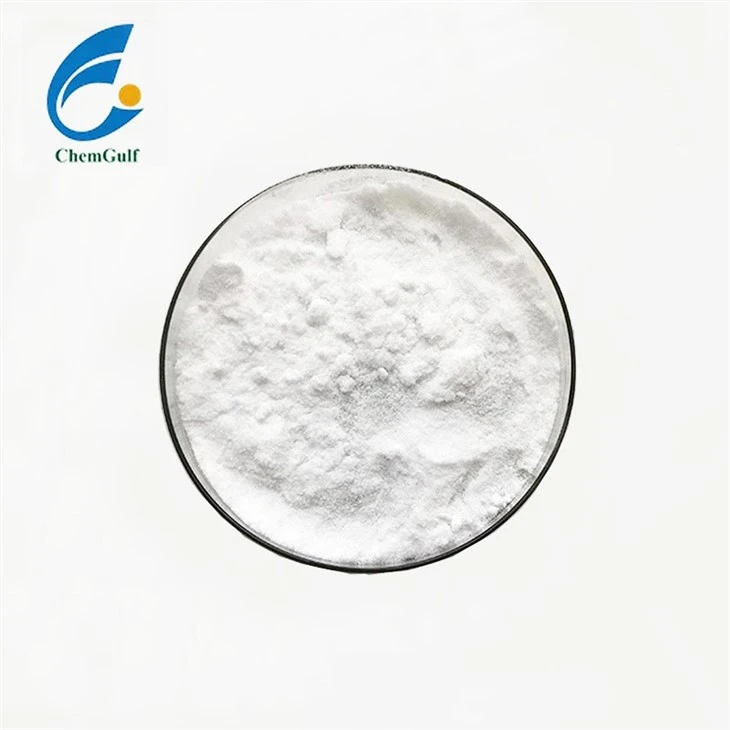
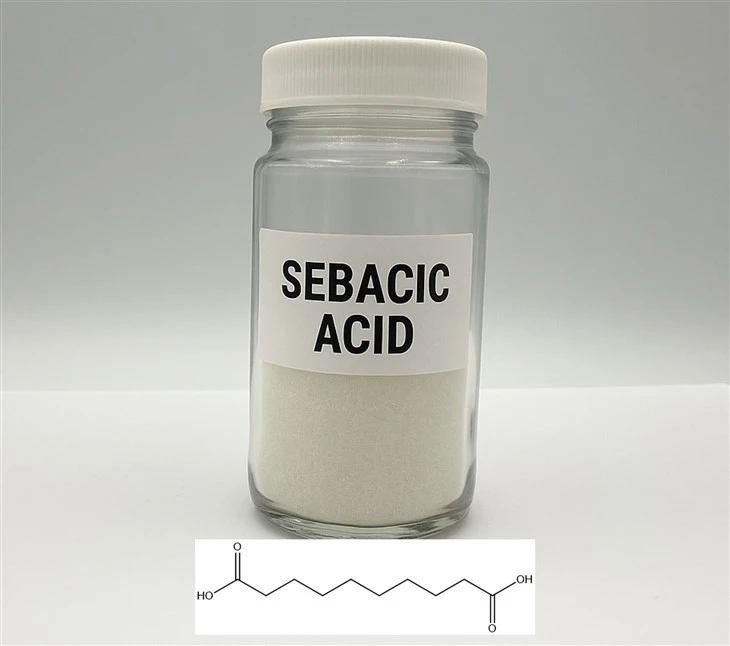

CG 217 Sebacic Acid (CAS 111-20-6) is a linear C10 dicarboxylic acid white solid used as a key bifunctional intermediate for polyamides, plasticizers, and synthetic lubricant esters.
Product Specifications & Grades
| Product Name | CG 217 Sebacic Acid |
|---|---|
| CAS Number | 111-20-6 |
| IUPAC Name | Decanedioic Acid |
| Other Names | Sebacic Acid; Octanedicarboxylic Acid |
| Molecular Formula | C₁₀H₁₈O₄ |
| Molecular Weight | 202.25 g/mol |
| Appearance (25°C) | White solid |
| Purity (%) | 98.5 Min |
| Total Dibasic Acid (%) | 99.5 Min |
| Moisture (wt%) | 0.3 Max |
| Ash (wt%) | 0.03 Max |
| Melting Point (°C) | 130–135 |
Molecular Structure & Chemical Reactivity
CG 217 Sebacic Acid is a saturated, straight-chain C10 aliphatic dicarboxylic acid with the formula HOOC–(CH₂)₈–COOH (C₁₀H₁₈O₄, MW: 202.25 g/mol).
Bifunctional Reactivity: The two terminal carboxyl groups connected by an eight-methylene chain enable key industrial reactions:
- Polycondensation: Reacts with diamines to form polyamide polymers (nylon).
- Esterification: Reacts with alcohols to produce monoesters or diesters (e.g., synthetic lubricants, plasticizers).
- Salt & Amine Reactions: Forms sebacate salts with inorganic bases or ammonium sebacates with organic amines.
Physical Properties: White powder; Melting Point 130–135°C; Boiling Point 294°C (at 100 mmHg); Density 1.21 g/cm³; Water Solubility 0.25 g/L (at 25°C).
Polymer & Nylon Manufacturing
CG 217 Sebacic Acid is a key C10 monomer used to produce high-performance polyamides and specialty polymers.
Polyamide Synthesis: Through condensation with diamines, it forms specific nylon grades:
- Nylon 6,10 (with hexamethylenediamine) for engineering plastics and fibers.
- Nylon 8,10 and Nylon 10,10 for specialty applications.
- Used in copolyamides to adjust polymer properties.
Performance Benefits: Imparts low moisture absorption, dimensional stability, chemical resistance, and mechanical toughness to molded parts and filaments.
Polyester & Alkyd Resins: Functions as a modifying monomer to adjust chain flexibility in specialty formulations.
Ester Derivatives & Plasticizer Production
CG 217 Sebacic Acid reacts with alcohols via esterification to produce sebacate esters, which are essential for plasticizers and synthetic lubricants.
Dioctyl Sebacate (DOS): Produced by esterifying sebacic acid with 2-ethylhexanol (and other branched-chain alcohols). DOS is a premium plasticizer offering superior low-temperature flexibility, volatility resistance, and resilience.
Key Applications: Widely used in PVC films, wire insulation, and synthetic rubber compounds that operate in cold environments.
Other Sebacate Esters: By selecting specific alcohols and controlling the esterification process, a wide range of monoesters and diesters can be produced for tailored formulation requirements.
Synthetic Lubricants: Sebacic acid serves as a key dibasic acid feedstock for high-performance synthetic ester base stocks and lubricant materials.
Manufacturing Process & Raw Material Source
CG 217 Sebacic Acid is manufactured using a renewable, bio-based feedstock, primarily castor oil.
Process Route: Castor oil undergoes alkaline hydrolysis to yield ricinoleic acid. This acid is then subjected to high-temperature alkaline cleavage (producing 2-octanol as a by-product), followed by acidification.
Purification: The crude sebacic acid undergoes multi-stage fractional crystallization and purification to remove colored impurities and volatile acids, ensuring high purity.
Bio-Based Advantage: Connecting the final product to a renewable vegetable-oil raw material supports sustainable and environmentally friendly chemical production.
Final Steps: The finished material is strictly inspected against specifications before industrial packaging.
Packaging & Supply Information
Packaging Options: Standard 25 kg composite paper-plastic bags with PE liners, as well as 500 kg bags and 1,000 kg FIBC jumbo bags. Custom packaging sizes are available upon request.
Supply & Availability: Bulk orders are supported for industrial manufacturing. Lead times depend on order quantity. TDS is available for download, and SDS is available upon request.
Storage Requirements: Store in a cool, dry, well-ventilated area, away from strong oxidizing agents and moisture. Keep containers tightly closed.
FAQ
Q: What is the primary raw material source for CG 217 Sebacic Acid?
A: It is derived from castor oil via the alkaline cracking of ricinoleic acid, making it a renewable, bio-based chemical intermediate.
Q: What is the role of sebacic acid in plasticizer production?
A: It is a dibasic acid used to manufacture sebacate esters (e.g., Dioctyl Sebacate / DOS). Its 10-carbon chain provides lower volatility and superior low-temperature flexibility compared to shorter-chain acids like adipic acid.
Q: What are the standard shipping classifications?
A: CG 217 is non-hazardous and not regulated as a dangerous chemical under major international codes for maritime, rail, and road transport.
Q: What is the Minimum Order Quantity (MOQ) and lead time?
A: The standard MOQ is 1 pallet. Standard production lead time is 10–15 business days after deposit confirmation, depending on stock availability.
Q: What are the payment terms for bulk orders?
A: We accept T/T (30% advance deposit, 70% balance against B/L copy) or Irrevocable L/C at sight. Exact terms are confirmed in the Proforma Invoice (PI).
Q: How can I request a sample before placing a bulk order?
A: Samples (typically 1 kg–2 kg) are available for laboratory testing. Please contact our sales team with your delivery address to arrange dispatch.
Specification
|
Property |
Specification |
Typical Value |
|
Appearance, 25 °C |
White solid |
White solid |
|
Purity, % |
98.5 min |
99 |
|
Total dibasic acid |
99.5 min |
> 99.5 |
|
Moisture, wt% |
0.3 max |
0.1 |
|
Ash, wt% |
0.03 max |
0.01 |
|
Melting Point, °C |
130 - 135 |
133 |
Custom specification is available upon request.
Packaging
25 kg / bag, 55 lbs / bag
500 kg / bag, 1,102 lbs / bag
1,000 kg / supersack, 2,204 lbs / supersack
Other packaging sizes available upon request
Pricing information / quote
Click here for prices.
Availability and Lead Time
Availability and lead time are dependent on the quantity of orders. Please contact us for more information.
Applications
CG 217, Sebacic acid, is useful for a variety of applications, which include, but are not limited to,
● Chemical intermediate
● Raw material to make nylons, including Nylon 1010, Nylon 610, Nylon 810, etc.
● Raw materials to make plasticizers, such as dioctyl sebacate.
● Raw material to make solvents.
● Raw material to make lubricant additives and synthetic ester base oils.
CG 217, Sebacic acid, is widely used in many industries, which include, but are not limited to, Plastics and rubber, lubricants, cosmetics, textiles, and pharmaceuticals, etc.
TDS / SDS
(A PDF available to download)
SDS, available upon request
Manufacturing Process
In the typical manufacturing process to produce Sebacic acid, castor oil is used as raw material. Hydrolysis of castor oil under basic conditions gives ricinoleic acid as an intermediate in the production. At a high temperature, ricinoleic is cleaved to produce Sebacic acid as the final product, with 2-octanol as the by-product.
Chemical Reactions
Sebacic acid can react with inorganic bases to form Sebacate salts.
Sebacic acid can react with organic amines to form ammonium Sebacates.
Sebacic acid reacts with alcohols to form esters via an esterification reaction. By adjusting the molar ratio of the adipic acid to the alcohol, the end product can be mono- or di- esters.
Sebacic acid reacts with diamines, such as hexamethylene diamine, to undergo a polymerization reaction.
Properties
|
Chemical Formula |
C10H18O4 |
|
Molecular Weight |
202.25 |
|
Appearance, 25 °C |
White powder |
|
Melting Point |
131 - 134 °C (268 - 274 °F) |
|
Initial boiling point |
294 °C (561 °F) at 100 mmHg |
|
Density, 20 °C, g/cm3 |
1.21 |
|
Solubility in water, 25 °C, g/L |
0.25 |
Spectra
NMR
Coming soon.
IR
Coming soon.
Links
See more products at www.chemgulfllc.com
Hot Tags: cg 217 sebacic acid, cas 111-20-6, decanedioic acid, octanedicarboxylic acid, China cg 217 sebacic acid, cas 111-20-6, decanedioic acid, octanedicarboxylic acid manufacturers


