

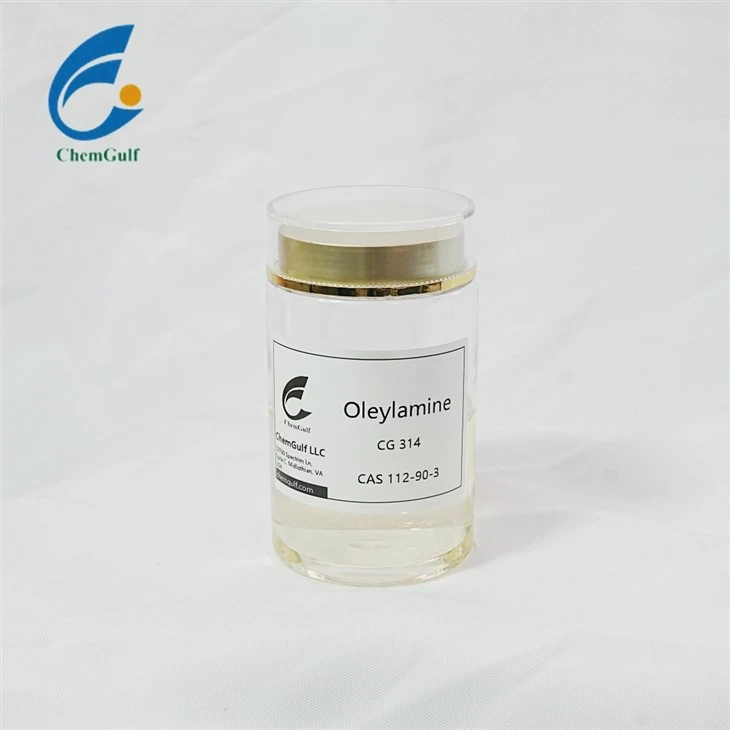
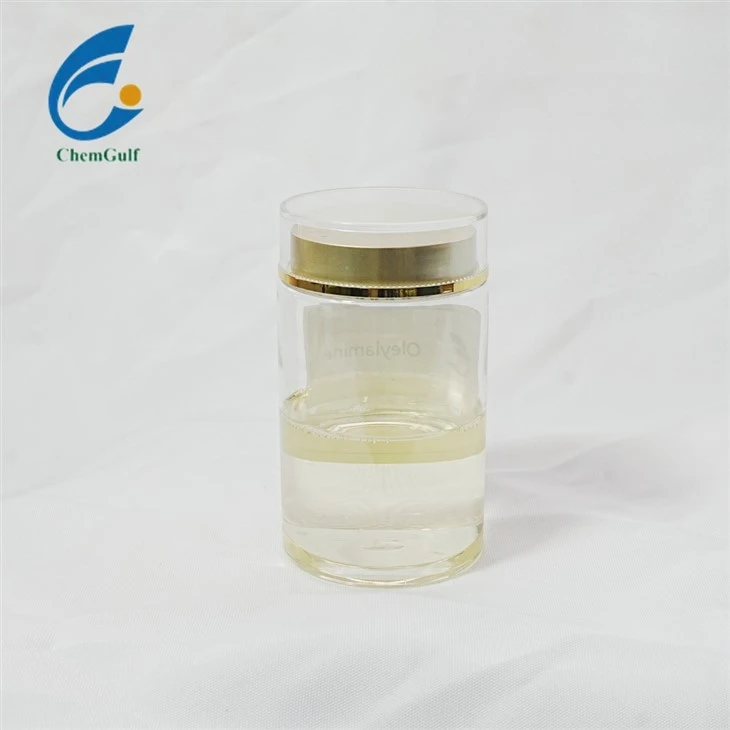
CG 314 Oleylamine (CAS 112-90-3; C18H37N, MW 267.49), a C18 unsaturated primary fatty amine with a reactive amino group and hydrophobic chain, is an industrial intermediate used in mineral flotation, lubricant additives, pigment dispersants, anti-rust formulations, textile auxiliaries, and surfactant production.

Technical Specifications
| Item | Specification | Typical Value |
|---|---|---|
| Product Code | CG 314 | CG 314 |
| Chemical Name | Oleylamine | Oleylamine |
| CAS Number | 112-90-3 | 112-90-3 |
| Synonyms | Oleamine, 9-Octadecenylamine, cis-9-Octadecenylamine | - |
| Chemical Family | Primary Fatty Amine | - |
| Molecular Formula | C18H37N | C18H37N |
| Molecular Weight | 267.49 g/mol | 267.49 g/mol |
| Appearance (25°C) | Light Yellow Liquid | Light Yellow Liquid |
| Total Amine Value (mg KOH/g) | 205–217 | 210 |
| Iodine Value (g I2/100 g) | 70 Min. | 89 |
| Freezing Point (°C) | 10–25 | 13 |
| Water Content (wt.%) | 0.30 Max. | 0.10 |
| Primary Amine Content (%) | 95 Min. | 99.0 |
Unsaturated C18:1 Structure & Functional Significance
- Structure: Straight 18-carbon chain with a single cis double bond at C9 and a terminal primary amino group - CH3(CH2)7CH=CH(CH2)8NH2
- Cis-C18:1 Chain: The cis double bond creates a kink that prevents tight molecular packing, keeping the compound liquid at ambient temperatures with lower viscosity than saturated C18 amines (e.g., stearylamine); provides hydrophobicity, surface mobility, and organic solubility.
- Reactive Primary Amine (-NH2): Serves as a strong base site for acid salt formation, coordination chemistry, and acylation to build functional derivatives.
- Unsaturation Indicator (Iodine Value): Spec: 70 g I2/100 g min (Typical: 89); a practical quality indicator for unsaturated-chain content.
- Industrial-Grade Composition: May contain other long-chain amines; amine value, iodine value, primary amine content, and water content are key selection indicators.
Application Spotlight: Mineral Flotation & Surface Modification
- Mineral Flotation & Nanoparticles: Cationic collector for non-sulfide ores (iron, phosphate, quartz, etc.); capping agent/ligand for colloidal metal nanoparticle synthesis.
- Lubricant & Fuel Additives: Raw material for anti-wear/friction modifiers; reacts with acidic phosphate esters to form amine phosphate salts.
- Corrosion & Anti-Rust: Forms hydrophobic protective films via amine salts on metals (pipelines, cooling water, acidic environments).
- Dispersants & Textiles: Pigment dispersant (particle affinity + organic compatibility); intermediate for fiber waterproofing/softening, antistatic, dyeing auxiliaries, and fertilizer anti-caking.
Formulation Chemistry & Reaction Pathways
- Salification (Acid Neutralization): Reacts with organic/mineral acids (e.g., acetic, HCl, H2SO4) to form water-soluble amine salts, used in surfactant and industrial formulations.
- Phosphate Ester Reaction: Reacts with acidic mono/di-phosphate esters to form amine phosphate salts, used as anti-wear and anti-rust lubricant additives.
- Amide Formation: Condenses with carboxylic acids or acyl chlorides to yield unsaturated fatty amides.
- Ethoxylation & Quaternization: Reacts with ethylene oxide to produce non-ionic polyoxyethylene amines (adjustable HLB); alkylates with alkyl halides or dimethyl sulfate to form unsaturated quaternary ammonium compounds.
Handling, Storage & Product Stability
- Physical State: Light yellow liquid at 25°C; freezing point ~13°C (may solidify at lower temperatures-maintain suitable temperature during storage, transfer, and unloading).
- Handling Temperature: Ambient preferred; if heating is required for transfer, do not exceed 60°C.
- Storage: Keep in tightly closed containers in a cool, dry, well-ventilated area away from direct sunlight, moisture, strong mineral acids, and oxidizing agents.
- Safety Precautions: Classified as a corrosive liquid. Wear appropriate PPE (chemical-resistant gloves, goggles, protective clothing); avoid vapor inhalation during high-temperature processing.
- Packaging: Standard: 160 kg/drum; other arrangements available upon request.
FAQ
Q: How does Oleylamine differ from Stearylamine?
A: Oleylamine is an unsaturated C18 primary amine (one cis double bond); Stearylamine is saturated. This difference affects iodine value and physical state.
Q: What is its main use in mineral processing?
A: A fatty amine collector in flotation formulations; the amine group binds to mineral surfaces while the hydrophobic chain drives separation.
Q: Can it be used in lubricant additives?
A: Yes. It reacts with acidic phosphate esters to form amine phosphate salts for anti-wear and anti-rust formulations.
Q: What role does it play in nanomaterial synthesis?
A: The amino group coordinates with metal surfaces, while the hydrocarbon tail provides steric hindrance, acting as a capping agent to control nanocrystal size/shape and colloidal stability.
Q: How is it prepared for water-based applications?
A: The free amine is water-insoluble; neutralize it with an equivalent acid (e.g., acetic acid) to form water-soluble amine acetate salts.
For product details, technical information, or a quotation, please contact our sales team.
Send InquirySpecifications of Oleyl amine CG 314
|
Property |
Specification |
Typical Value |
|
Appearance, 25 °C |
Light yellow liquid |
Light yellow liquid |
|
Total Amine Value, mg KOH / g |
205-217 |
210 |
|
Iodine Value, g / 100g |
70 Min |
89 |
|
Freezing Point, °C |
10 - 25 |
13 |
|
Water content, % wt |
0.3 Max |
0.1 |
|
Primary amine content, % |
95 Min |
99.0 |
Packaging
N.W.: 160KG/Drum;
Other packaging available upon request
Availability and Lead Time
The product is available in our warehouses in the US. Product usually shipped out within two days after purchase order is received.
Applications of Oleylamine
Oleylamine is mainly used as the intermediate of surfactants. It is also used as additives in emulsifiers.
Major applications include lubricant additives, mineral flotation agents, waterproof softener of fibers, dyeing auxiliaries, anti-static agents, pigment dispersants, anti-caking agents of fertilizers, anti-rust agents.
TDS / SDS
(A PDF available to download)
SDS, available upon request
Manufacturing Process
Industrial oleylamine is manufactured through multiple-step chemical reactions. Oleic acid (set a link here) is typically used as a starting material, which is converted into the nitrile intermediate. Then high-pressure hydrogenation reduces the nitrile intermediate into the desired oleylamine.
The refinement of the end product usually includes distillation and filtration.
Chemical Reactions
Oleylamine is an organic primary amine. It reacts with organic carboxylic acid, such as oleic acid, to form an organic ammonium salt. The salt can be converted into the corresponding amide by the loss of one water molecule under high temperatures or with the appropriate catalysts. Oleylamine also forms ammonium phosphate salts with acidic phosphate esters, such as mono- and di- phosphate esters. These ammonium phosphates can be used as anti-wear and / or anti-rust agents in lubricant industry.
Oleylamine reacts with inorganic acids, such as hydrochloric acid and sulfuric acid, to form ammonium salts.
Oleylamine reacts with acetic halides, such as acetic chloride, to form acetic oleyl amide.
Properties
|
Chemical Formula |
C18H37N |
|
Molecular Weight |
267.5 |
|
Appearance |
Paste, semi-solid melting to a colorless liquid |
|
Melting Point |
25°C (77°F) |
|
Initial boiling point and boiling range |
196 - 199°C (385 – 390 °F) at 20 hPa |
|
Flash point, closed cup |
154°C (309°F) |
|
Density |
0.830 g/cm3 |
Spectra
NMR
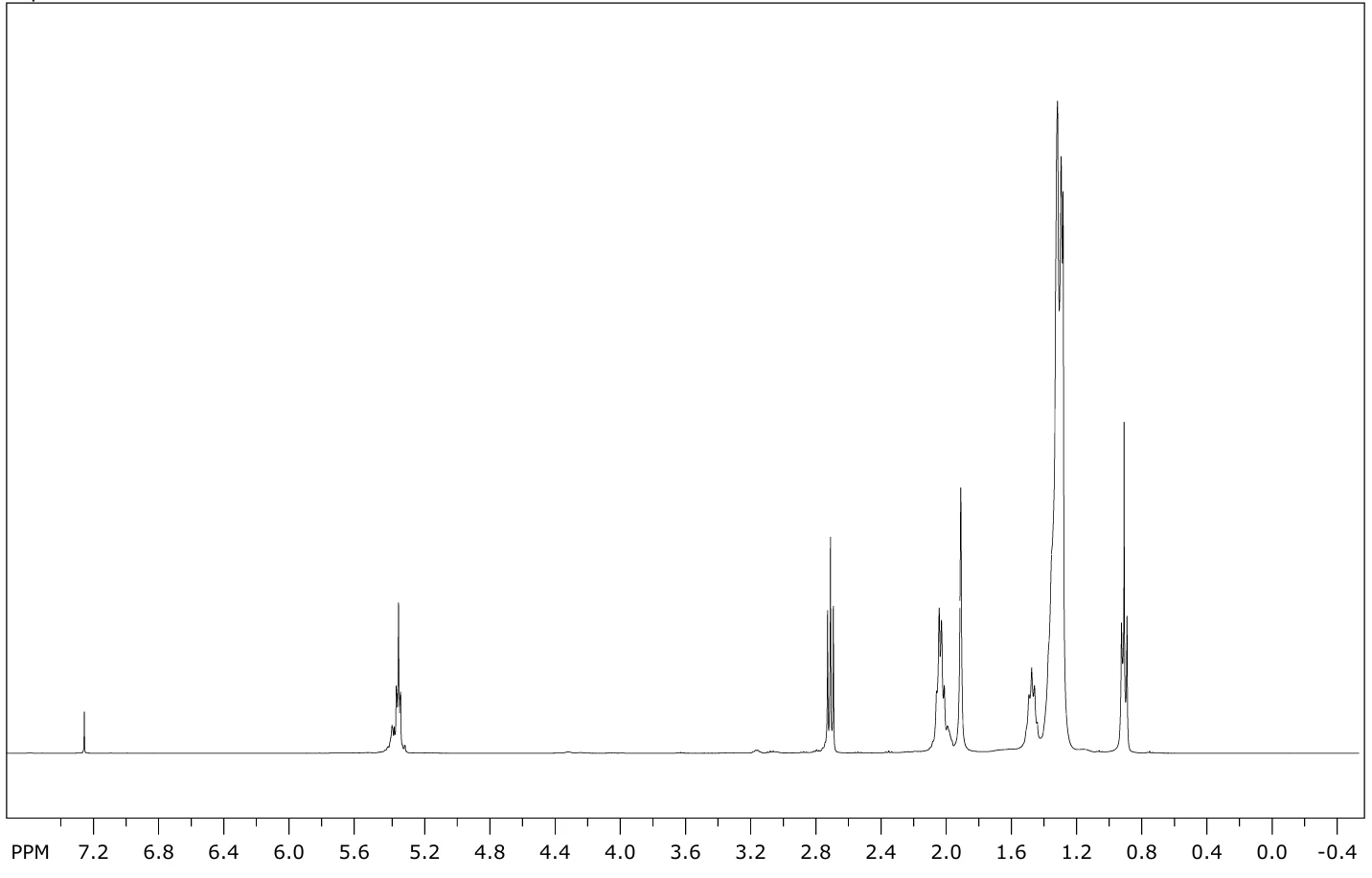
IR: Not Available
Links
See more products at www.chemgulfllc.com
Hot Tags: cg 314 oleylamine, cas 112-90-3, oleamine, China cg 314 oleylamine, cas 112-90-3, oleamine manufacturers


