

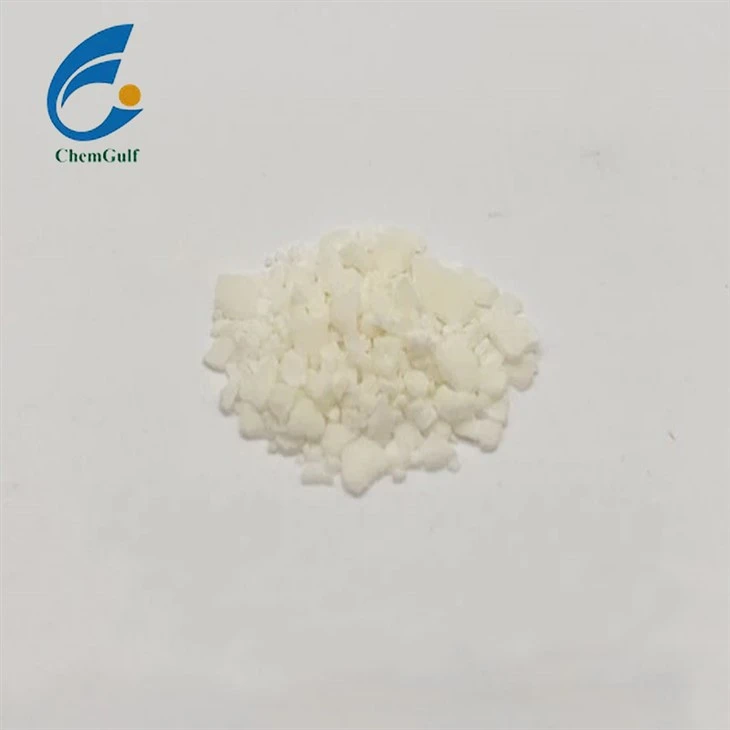

CG 315 Stearylamine (Octadecylamine), an industrial-grade saturated C18 primary fatty , is used in surfactant production, detergents, mineral flotation, and fertilizer anti-caking.
Technical Specifications
| Item | Information / Specification |
|---|---|
| Product Name | CG 315 Stearylamine |
| Chemical Name | Stearylamine / Octadecylamine |
| Chemical Type | C18 Saturated Primary Fatty Amine |
| CAS Number | 124-30-1 |
| Molecular Formula | C₁₈H₃₉N |
| Molecular Weight | 269.51 g/mol |
| Appearance (25°C) | White solid |
| Primary Amine Content (%) | >98 |
| Total Amine Value (mg KOH/g) | 200–215 |
| Iodine Value (g I₂/100 g) | 2 Max. |
| Water Solubility | Insoluble in water |
| Organic Solubility | Soluble in many organic solvents |
Carbon Chain Distribution
| Component | Content |
|---|---|
| C18 (Octadecylamine) | ≥ 90.0% |
| C16 (Hexadecylamine) | ≤ 7.0% |
| Other Homologs (C14 & lower / C20) | ≤ 4.0% |
Product Chemistry & Functional Properties
Cationic Reactivity (Salt Formation)
High basicity from the primary amine group readily forms stable, water-dispersible salts with organic/inorganic acids (e.g., acetic, phosphoric) for emulsions and corrosion inhibitors.
Surface Adsorption (Monolayer Formation)
The polar amine head anchors to mineral, metal, or pigment surfaces, while the tightly packed C18 tail projects outward to impart water repellency, lubrication, and anti-static properties.
Industrial Applications & Formulation Uses
Surfactants & Quats
Precursor for cationic surfactants, phase-transfer catalysts, and multi-chain quaternary ammonium compounds.
Organoclays
Key alkyl-ammonium precursor for modifying clays into thixotropic thickeners for paints, greases, and sealants.
Fertilizer Anti-Caking
Hydrophobic coating component (e.g., for ammonium nitrate/urea) to prevent moisture absorption and caking.
Mineral Flotation & Lubricants
Collector for silicate/non-metallic mineral flotation; boundary lubricant and mold release agent for metalworking and polymer processing.
Textile Auxiliaries
Softening, antistatic, and lubrication finish component for natural and synthetic fibers.
Packaging, Supply & Commercial Information
Packaging
Standard 160 kg metal drums and 900 kg IBC tanks. Additional options (e.g., 25 kg lined bags, bulk) are negotiable upon request.
Storage & Handling
Store in a cool, dry, well-ventilated area away from direct sunlight, strong oxidizers, and mineral acids. Keep containers tightly closed to prevent moisture/CO₂ absorption. Shelf life: 24 months (unopened).
Commercials
Bulk pricing and shipment arrangements are available upon inquiry. Please provide quantity, destination port, packaging preference, and intended application to receive a quote. TDS, SDS, and batch-specific COA (subject to availability) are provided.
Send InquiryFAQ
Q: What is the difference between CG 315 and unsaturated amines (e.g., oleylamine)?
A: CG 315 has a saturated C18 chain, allowing closer molecular packing for higher melting points, superior film integrity, and greater structural stiffness compared to unsaturated amines.
Q: Is it soluble in water, and how is it dispersed?
A: No. It is insoluble in water but soluble in organic solvents. For water-based systems, it must be neutralized with an acid (e.g., acetic acid) to form water-dispersible amine salts.
Q: What precautions are needed during melting/high-temperature storage?
A: Blanket melt tanks with dry nitrogen, keep temperatures strictly below 80–90°C, and avoid prolonged air exposure to prevent thermal darkening and CO₂ reaction.
Q: What are the packaging and storage conditions?
A: Standard 160 kg drums and 900 kg IBC tanks. Store in a cool, dry area away from direct sunlight at ambient temperature.
Q: How do I request a TDS, SDS, COA, or quotation?
A: Contact our sales team with your required volume, destination port, and packaging preference. We will provide a formal quote along with the TDS, SDS, and batch-specific COA.
Specification
|
Property |
Specification |
Typical Value |
|
|
Appearance, 25 °C |
White solid |
White solid |
|
|
Total Amine Value, mg KOH / g |
200 - 215 |
207 |
|
|
Iodine Value, g / 100g |
2 Max |
< 2 |
|
|
Freezing Point, °C |
47 - 54 |
50 |
|
|
Moisture |
0.3 Max |
0.15 |
|
|
Primary amine content, % |
98 min |
> 98 |
|
|
Carbon chain distribution |
C18 |
> 90 |
Meet specification |
|
C16 |
< 7 |
||
|
other |
< 4 |
||
Packaging
160 kg metal drums
Other packaging available upon request
Pricing information / quote
We guarantee our prices are the most competitive.
All prices below are delivered within the US, excluding Alaska and Hawaii.
1-8 drums: $4.15/lb
9-20 drums: $3.75/lb
21-40 drums: $3.35/lb
Over 40 drums: $3.25/lb
Prices for other packaging, Please contact us.
Availability and Lead Time
Availability and lead time are dependent on the quantity of orders. Please contact us for more information.
Applications
Stearylamine is mainly used as the intermediate of surfactants. It is also used as additives in emulsifiers.
Other major applications include mineral flotation agents, anti-caking agents of fertilizers and waterproof softener of fibers.
TDS / SDS
(A PDF available to download)
SDS, available upon request
Manufacturing Process
Industrial stearylamine is manufactured through multiple-step chemical reactions. Stearic acid (set a link here) is typically used as a starting material, which is converted into the corresponding nitrile intermediate. Then high-pressure hydrogenation reduces the nitrile intermediate into the desired stearylamine.
Chemical Reactions
Stearylamine is an organic primary amine. It reacts with organic carboxylic acid to form an organic ammonium salt. The salt can be converted into the corresponding amide by the loss of one water molecule under high temperatures or with the appropriate catalysts. Stearylamine also forms ammonium phosphate salts with acidic phosphate esters, such as mono- and di- phosphate esters. These ammonium phosphates can be used as anti-wear and / or anti-rust agents in lubricant industry.
Stearylamine reacts with inorganic acids, such as hydrochloric acid and sulfuric acid, to form ammonium salts.
Stearylamine reacts with acetic halides, such as acetic chloride, to form acetic stearyl amide.
Properties
|
Chemical Formula |
C18H39N |
|
Molecular Weight |
269.5 |
|
Appearance |
White solid |
|
Melting Point |
53°C (127°F) |
|
Boiling point |
232°C (450 °F) at 4.3 kPa |
|
Flash point, closed cup |
149°C (300°F) |
|
Density |
0.86 g/cm3 |
Spectra
NMR: Not Available
IR: Not Available
Links
See more products at www.chemgulfllc.com
Hot Tags: cg 315 stearylamine, cas 124-30-1, stearamine, n-octadecylamine, competitive price, China cg 315 stearylamine, cas 124-30-1, stearamine, n-octadecylamine, competitive price manufacturers


